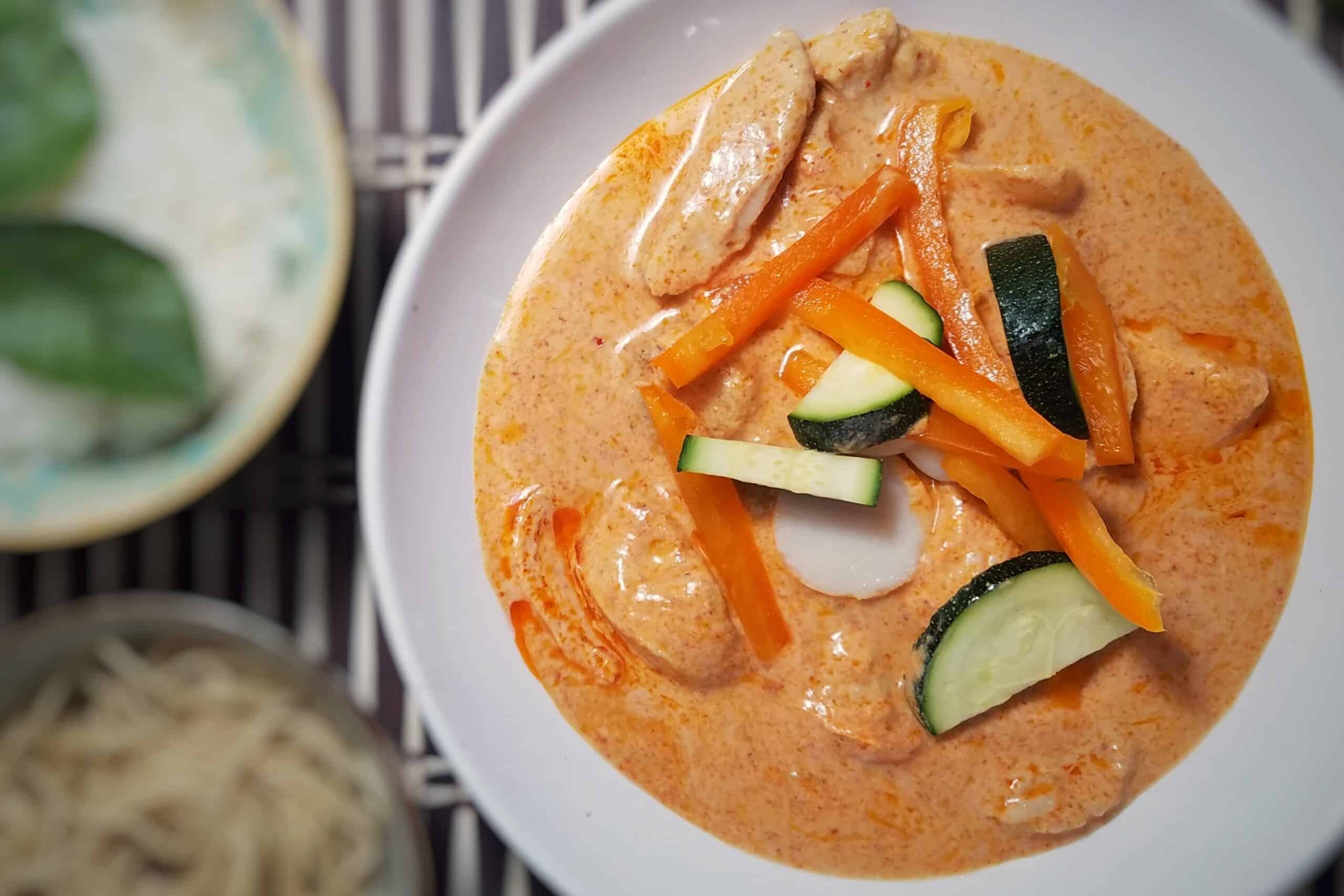
If you’ve ever felt a twinge of disappointment at making a curry that wasn’t quite as good as the one at your favorite restaurant, here are the secrets to making the best Restaurant Style Thai Curry!
When I was in college, I lived next to a Thai restaurant that I frequented at a rate that could possibly be considered a minor invasion. They were so nice to me around there. When I graduated, I ended up moving far far away from my beloved restaurant; but not without asking the owners to teach me their secrets before I left. This recipe is the result of what they taught me through diagrams, descriptions and a language barrier; as well as diligent note-taking and several successful (and less successful) attempts.
At their core, most Thai curry recipes and techniques are essentially the same. The truth is, what makes the difference is the quality of the ingredients you choose to use. For this specific recipe, unlike most of my others, I really do recommend using the brands that I have listed. That’s where the magic comes from. The three key ones are Savoy Coconut Cream, Maesri Curry paste and Red Boat 40°N fish sauce.
Below are the brands I’m talking about. I want to note that this photo has a can of panang curry paste. That just happened to be what I had when I was taking pictures! Typically I use red curry paste for this recipe, but you can totally use panang curry paste instead. Both are great.
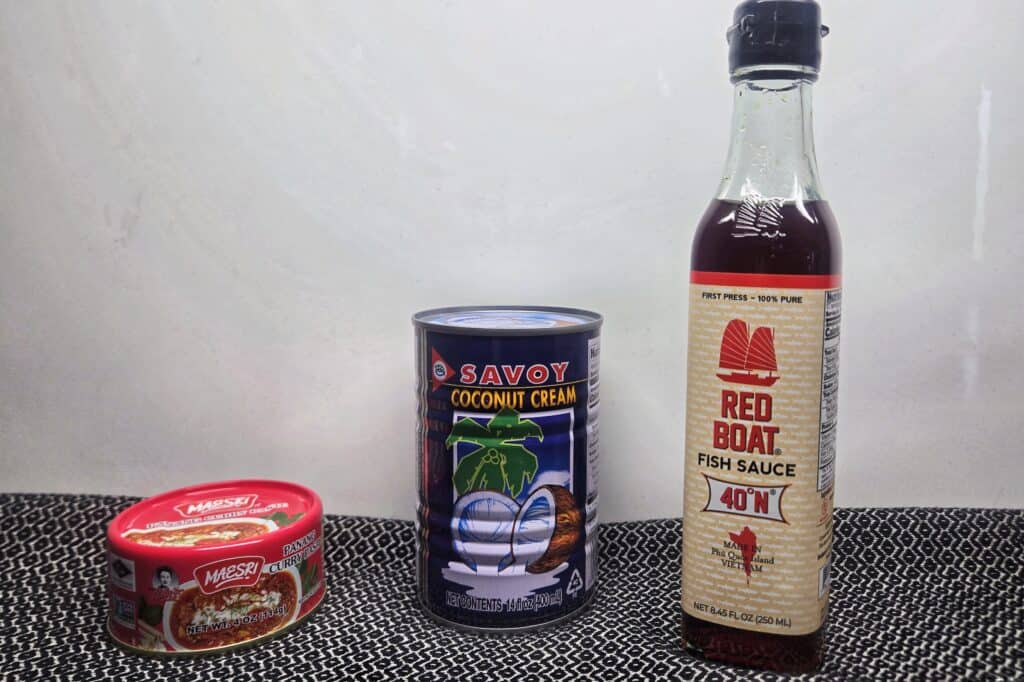
Let’s get into the weeds about some of these ingredients. This is all information worth mentioning, but boy was this page getting long. Click each of the ingredients to get a little more information about them. You’ll stay on this page.
Curry Paste ⇒
Curry paste is a strongly aromatic blend of oil and spices and is the foundation of all curry recipes.
While curry paste can be made at home- and there are myriad recipes on the internet to do just that- I have found a curry paste I love so much I don’t even have the desire to try to make my own. The owners of my favorite Thai restaurant recommended MAESRI BRAND curry paste and they were absolutely right. I haven’t had another curry paste that I like nearly as much. It is spicy and complex and an absolute must-have for my Thai Curry recipe. I always get mine from my local Asian market, although it is also available online. You may have to buy in bulk online! Unlike some of the other products suggested in my Thai recipes, this one I’ve have had a little luck finding at specialty and fine foods stores. I even once found it at a shop in tiny Montrose, Colorado. Keep your eyes peeled!
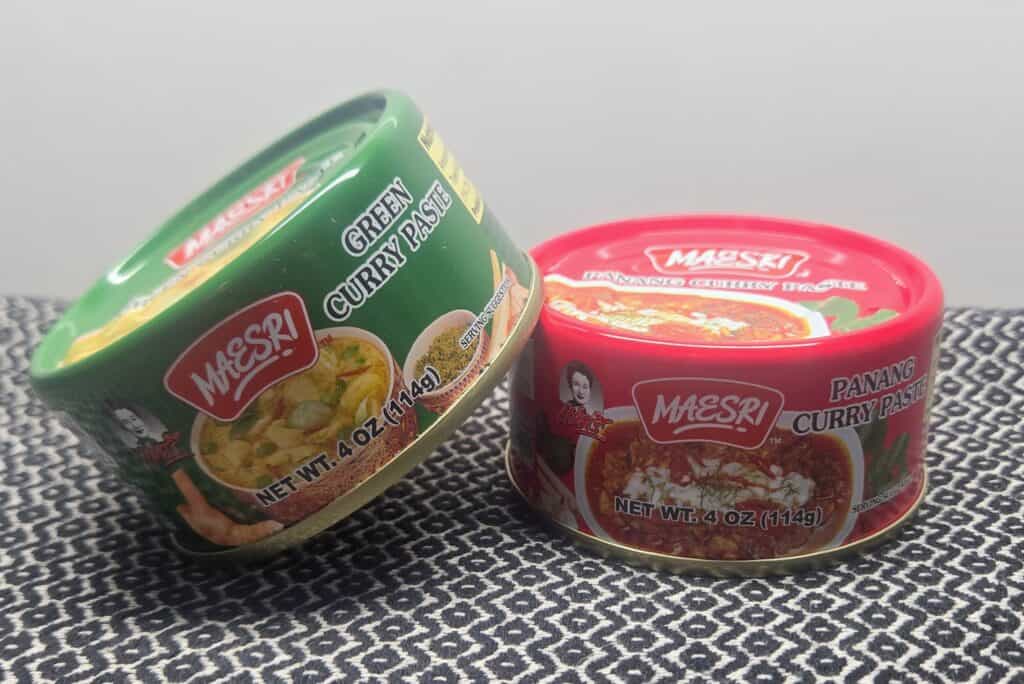
Above is a picture of Maesri curry pastes in green and panang. Note that I typically use red curry paste, but panang was what I happened to have when I took pictures! Either one will make an excellent Thai red curry.
No matter what curry paste you decide to go with, I just beg one thing- please don’t use your local store brand or the extremely common Thai Kitchen brand. They’re just not that good. This is an easy way to improve your Thai curry game without making any other changes!
Coconut Cream ⇒
Coconut cream is similar to coconut milk but significantly richer and creamier; much in the same way that milk is related to cream. The content of coconut extract is significantly higher than in canned coconut milk- my preferred brand is 70% extract and 30% water. There are many brands commercially available.
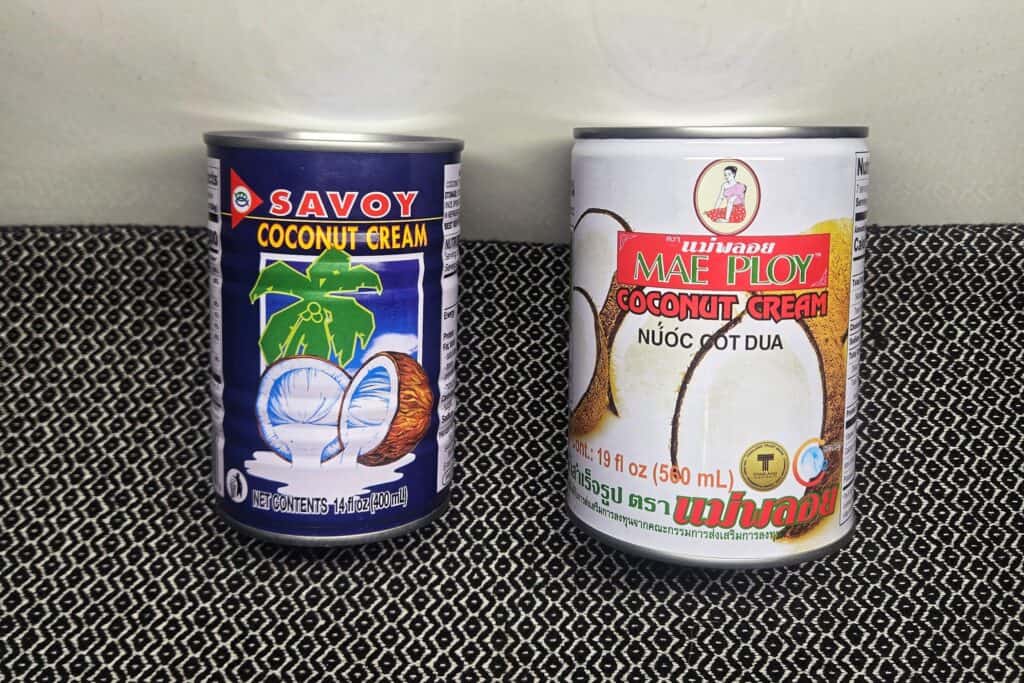
Using any brand of canned coconut cream instead of canned coconut milk will instantly and drastically improve your Thai curry recipes. That said, I do have a few preferences. First, I always prefer that my coconut cream has zero emulsifiers or stabilizers such as guar gum, xanthan gum or carrageenan. This is because, in addition to generally trying to avoid those types of artificial ingredients, if the solution isn’t emulsified the coconut cream will float to the top of the water. If unmixed, you can scoop out just the coconut cream- leaving behind the water- for ultimate decadence. Having tried several brands, my absolute favorite is SAVOY. This is the one I recommend for my Thai curry recipe. I can’t find it in any grocery stores in my area; I have to make a trip to the Asian specialty store for this one. Of course you can purchase it online as well. My second favorite coconut cream brand is MAE PLOY.
Palm Sugar ⇒
Palm sugar is made by boiling sap from palm trees until it thickens and hardens. It has a rich sweetness that is sort of comparable to brown sugar. It is an item that you may be able to find at your supermarket or natural grocer although I typically buy mine at an Asian specialty store.
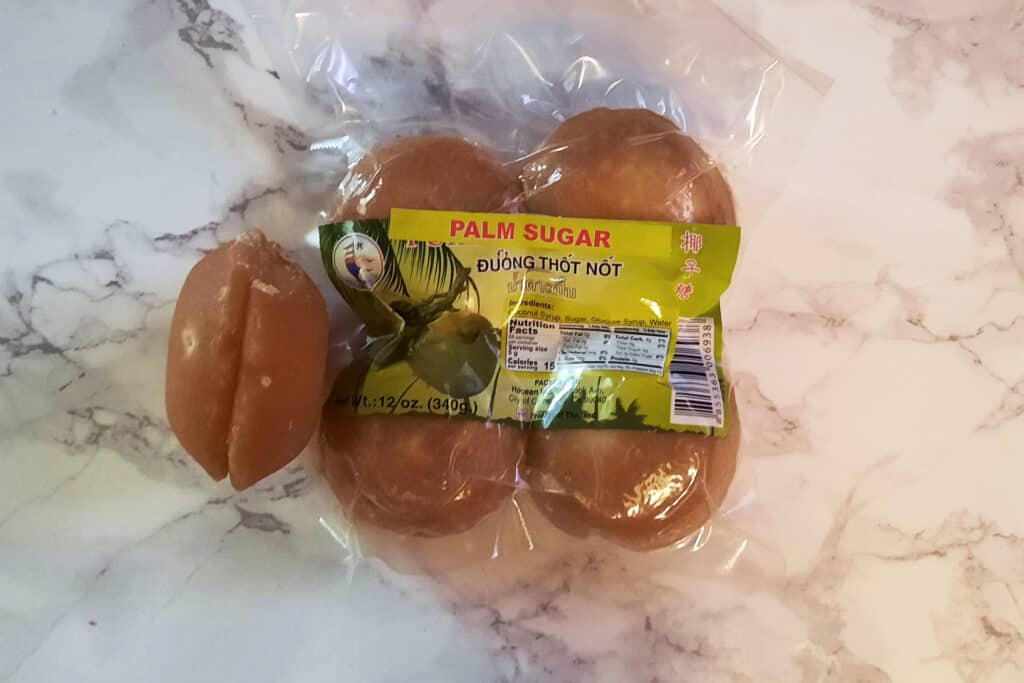
Palm sugar is one of the few things I haven’t tested extensively across brands. I found one I liked and stuck with it. I prefer palm sugar that is hardened into half spheres. For the curry recipe, I use two half spheres, melted into water. That’s the amount you see outside of the packaging above. The rounds I use are a total of 3 oz apiece; of course you can use an equivalent amount of the granulated kind as well. I would still recommend melting it into the water, however. Click here to get some more information about palm sugar, what it is and where to find it.
Kaffir Lime Leaves ⇒
Kaffir lime leaves are a common ingredient in Thai cooking. While they can be eaten sliced, generally I use them like you would bay leaves- put them in what you’re simmering for flavor and then remove them when you’re done. Kaffir limes are a specific type of lime- regular lime leaves won’t work or really add any flavor.
These are a pretty specific ingredient and I have had absolutely no luck finding them at regular grocery or specialty stores in my area. However if you live in a major city, it may be worth checking near the fresh herbs, as some major retailers do sell them (so I’m told). I have to go to my favorite Asian specialty store- and not all of them even carry these leaves. If you have more than one Asian grocer in your area, your best bet will be whichever one has the largest selection of Thai or Southeast Asian ingredients. They can be found in the produce section, usually in the refrigerated area. My store only sells them in fairly large bags- but don’t worry about having too many. Kaffir lime leaves freeze really well. I’ve found they still retain their flavor and texture even after being frozen for a year. I’ve heard they can sometimes be bought in the freezer section of Asian stores as well, although I haven’t found any in mine.
If you are absolutely unable to find them at all, I would say that (for curry specifically) this is the one thing that you COULD skip. For maximum awesomeness they should be in there but it will not drastically reduce the quality of your recipe if they’re absent. There aren’t really any other substitutions for these leaves available.
Fish Sauce ⇒
Ah, fish sauce. The grossest-smelling key ingredient that you need in your life. Even though fish sauce is only used by the teaspoon in most recipes, it’s one of those things that you really shouldn’t skip. It adds a depth of umami flavor to many foods that can’t be replicated any other way. Don’t be turned off by the smell- the flavor it adds won’t taste anything like it. Often used in Asian recipes, you can also find it in my Ultra Umami Mushroom Gravy recipe and a variety of other worldwide foods.
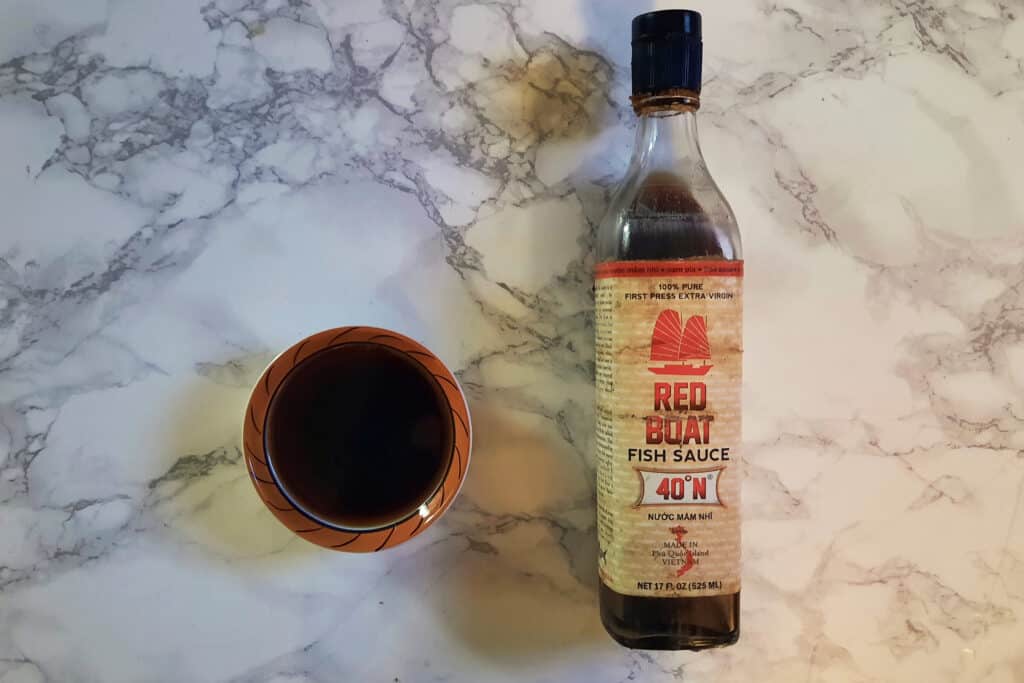
Having tried a few brands, my absolute favorite (as is many peoples) is 40 DEGREE NORTH fish sauce. The difference really is noticeable. It’s definitely one of the most expensive options out there but in my opinion it’s totally worth it- and since you never use too much of it at once it’ll last you forever. Unlike some of the ingredients in my Thai recipes, 40 Degree North fish sauce is fairly easy to find. In my area the cheapest option is at my favorite Asian specialty store, but they also sell it at Whole Foods and some specialty / fine food grocers.
Thai Chilis ⇒
Thai chilis are also known as bird’s eye chilis. They are very small and slender and both green and red. They are very spicy- a little goes a long way. I am a spicy food monster and I usually only use 1-3 in a recipe. The green ones will light you up immediately and the red ones will provide more of a slow burn.
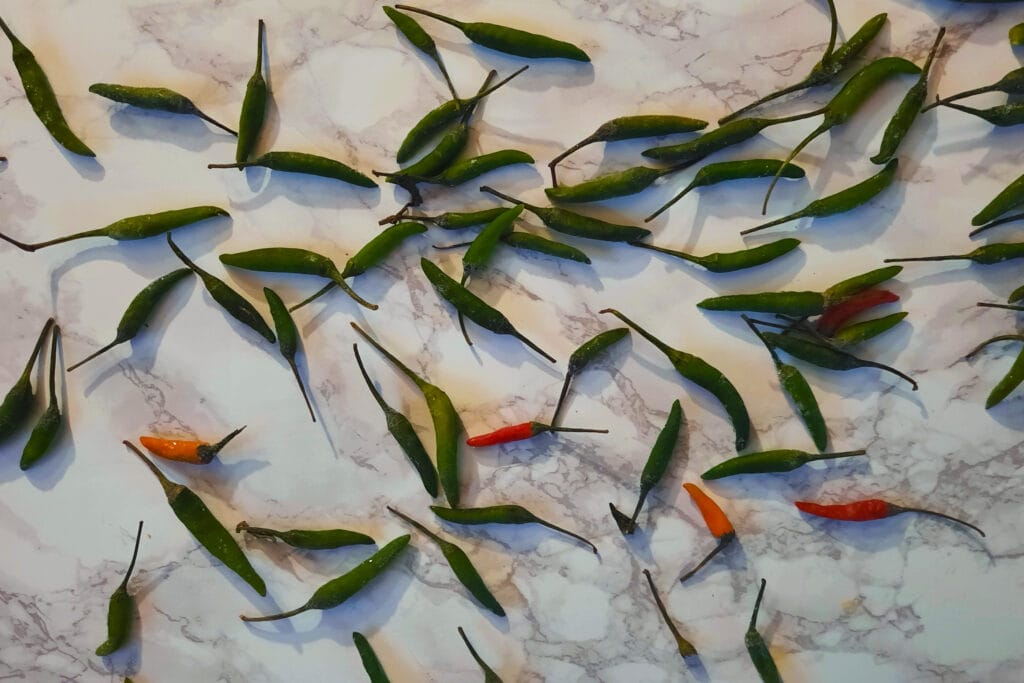
Your local supermarket may carry them although mine do not. I have to go to my favorite Asian supermarket to buy mine. They can be found in the produce section, often in the refrigerated area. My store only sells them in large bags, but fortunately they freeze very well. There will be some texture loss but that shouldn’t affect this recipe too much. You can find more about using and storing these peppers here.
And so here it is, the recipe that kind of began this whole thing.
Looking for more awesome recipes from around the world? Check out my Punjabi Rajma Masala, Cuban Picadillo and Hatch Chiles Rellenos recipes!
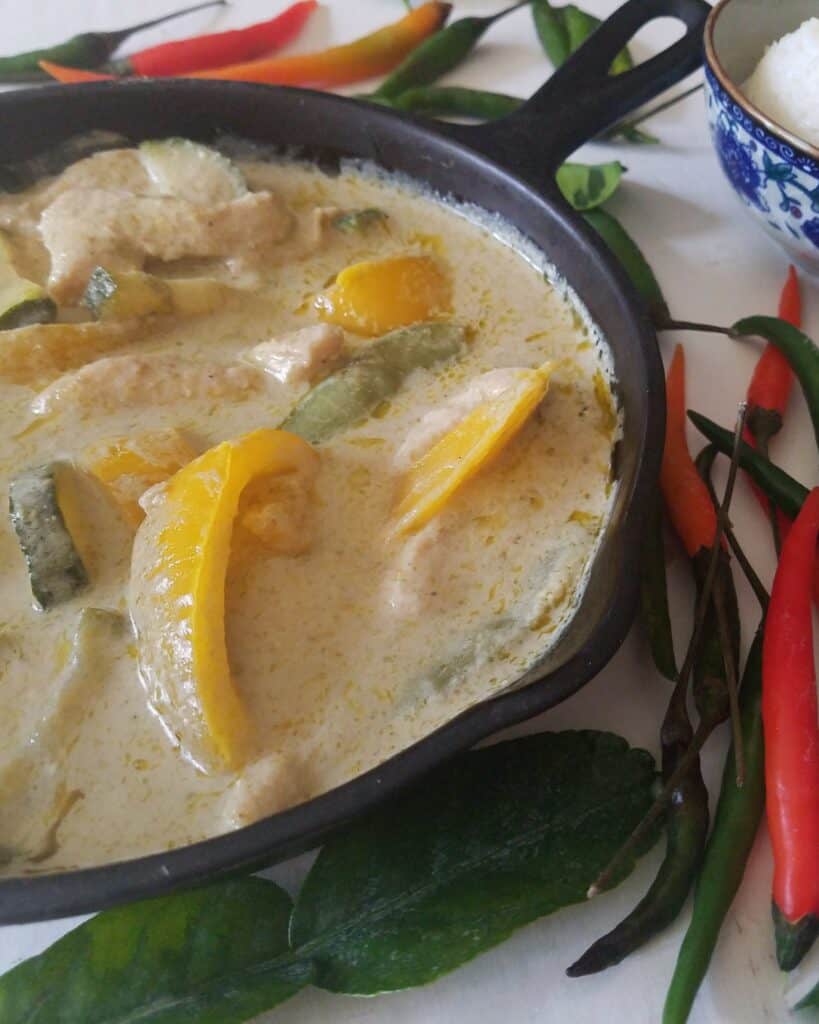
Restaurant Style Thai Curry
Ingredients
- 1 medium zucchini
- 1/4 lb snow peas
- 1/2 bell pepper, color of choice
- 1 lb thin-sliced chicken
- 1/2 cup peanut oil, slightly underfilled
- 1-3 Thai chilis (red or green)
- 1 4 oz can Maesri red or green curry paste
- 1 14 oz can Savoy coconut cream
- 2 kaffir lime leaves
- 1 tsp chicken bouillon
- 3 oz palm sugar "round" (see note above)
- 2 wedges lime (about 1/4 lime)
- 1 tsp Red Boat 40°N fish sauce
- white rice, for serving
Instructions
- Slice the zucchini into half-medallions. Trim the ends and the string off the snow peas. Cut the bell pepper into slices.
- Slice chicken into 3/4 inch strips.
- In a wok or heavy-bottomed pan, heat peanut oil until just before smoking.
- Add Thai chilis and curry paste to the pan. Cook for about a minute, stirring constantly, until fragrant.
- Add 14-oz coconut cream to the pot. Bring to a boil and add chicken, stirring to combine. Cook for 10 minutes, monitoring the heat to make sure it doesn't boil over.
- Add vegetables, kaffir lime leaves and bouillon, reducing heat as necessary. Cook for another 10 minutes.
- Place palm sugar in a microwave safe dish and add 1/4 cup water. Microwave at 5-10 second intervals until the sugar dissolves entirely, about 1.5 minutes. Stir occasionally to break up the lumps.
- After 10 minutes are up, remove curry from heat. Stir in dissolved sugar, juice from the lime wedges and fish sauce. Serve over rice. (Protip: add a little coconut oil to your rice as it cooks!)
Currently Listening: Eric Prydz – Opus